par guezio.com | Juil 23, 2026 | Affiliation
Il y a des chaussures qu’on achète pour le style, et il y a des chaussures qu’on achète parce qu’on sait qu’on ne les enlèvera plus. Le Crocs Classic Clog Noir appartient clairement à la seconde catégorie. Depuis son lancement en 2002, la marque en a écoulé plus de 300 millions de paires dans plus de 90 pays, un chiffre qui ne s’explique pas par un simple effet de mode. Ce sabot au look reconnaissable entre mille a traversé les moqueries, les collections capsules avec des designers de luxe, et les recommandations de podologues, pour devenir un incontournable du vestiaire décontracté. Crocs Classic Clog Noir le sabot le plus vendu au monde mérite-t-il
Alors, simple tendance récupérée par les réseaux sociaux ou véritable outil de confort au quotidien ? On a passé ce modèle iconique au crible : matériaux, confort, entretien, avis clients, et rapport qualité-prix. Voici ce qu’il faut savoir avant de cliquer sur « Ajouter au panier ».
Pourquoi le Crocs Classic Clog fait autant parler de lui
Le succès du Classic Clog ne tient pas au hasard. C’est le modèle fondateur de la marque, celui qui a donné naissance à toute une famille de sabots déclinés en version plateforme, fourrée, ou à bride réglable. Sa reconnaissance mondiale s’appuie sur trois piliers simples : une silhouette immédiatement identifiable, un matériau breveté unique sur le marché, et un prix qui reste accessible malgré la popularité du produit.
Sur Amazon.fr, le modèle Classic Clog Noir figure régulièrement dans les meilleures ventes de la catégorie chaussures, toutes générations confondues. Les avis clients dépassent souvent la note de 4,5 sur 5, avec des retours qui reviennent systématiquement : légèreté surprenante, facilité d’entretien, et une capacité à s’adapter à des usages très différents, du jardinage à la sortie décontractée en ville.
La matière Croslite : le vrai secret du confort Crocs
Ce qui distingue vraiment ce sabot de n’importe quelle chaussure en caoutchouc classique, c’est sa matière propriétaire : le Croslite. Il s’agit d’une mousse résine fermée, ni plastique ni caoutchouc traditionnel, spécialement conçue pour offrir un amorti proche du sur-mesure. Sous la chaleur du pied, le matériau se ramollit légèrement et épouse peu à peu la forme du pied de son propriétaire, un peu à la manière d’une semelle de running haut de gamme, mais dans une chaussure vendue à un prix bien plus doux.
Cette matière présente aussi l’avantage d’être extrêmement légère. Une paire complète ne pèse qu’une fraction du poids d’une chaussure fermée classique, ce qui explique pourquoi tant d’utilisateurs décrivent une sensation de « marcher sur des nuages » dès les premières minutes de port. Autre atout non négligeable : le Croslite est résistant à l’eau et flotte, ce qui en fait un compagnon idéal pour la piscine, la plage, ou simplement les jours de pluie où on ne veut pas abîmer ses chaussures habituelles.
Un design pensé pour la respirabilité et la praticité
Les perforations caractéristiques réparties sur le dessus du sabot ne sont pas qu’un détail esthétique. Elles jouent un rôle fonctionnel important : elles permettent à l’air de circuler librement et à l’eau de s’évacuer instantanément, deux qualités précieuses pour les journées chaudes ou les activités où le pied transpire beaucoup.
La bride arrière rabattable est un autre point fort du design. Elle peut se porter relevée pour un maintien renforcé du talon, idéal pour la marche ou les déplacements actifs, ou abaissée à l’arrière pour un usage façon mule, pratique pour enfiler et retirer le sabot en quelques secondes. Cette double fonctionnalité en fait une chaussure aussi adaptée à une sortie rapide sortir les poubelles qu’à une balade prolongée.
Le col surélevé enveloppe le pied et limite les frottements, tandis que la semelle extérieure, avec ses crampons discrets, apporte une accroche correcte sur la plupart des surfaces, y compris les sols mouillés ou légèrement glissants.
Un modèle unisexe qui s’adapte à toutes les morphologies
Le Crocs Classic Clog Noir est pensé comme un modèle unisexe, avec une coupe standard qui convient aussi bien aux pieds fins qu’aux pieds larges. C’est justement cette tolérance de forme qui explique pourquoi tant de personnes ayant des problèmes de confort avec les chaussures classiques se tournent vers ce sabot : bunions, pieds sensibles, gonflements en fin de journée, ou simplement besoin d’espace pour les orteils.
Le guide des tailles Crocs recommande généralement de prendre sa pointure habituelle, voire une demi-taille en dessous si l’on préfère un maintien plus serré. Pour les indécis entre deux tailles, mieux vaut opter pour la plus grande : la matière Croslite ne s’étire pas dans le temps comme un tissu, donc autant partir sur un ajustement confortable dès le départ.
Facilité d’entretien : un argument sous-estimé
Dans un monde où beaucoup de chaussures demandent un entretien minutieux, le Classic Clog Noir se distingue par sa simplicité absolue. Un coup d’éponge avec de l’eau savonneuse suffit généralement à retirer la boue, la poussière ou les taches du quotidien. La couleur noire, en particulier, a l’avantage de masquer facilement les petites marques d’usure visibles sur les coloris plus clairs.
Cette robustesse au lavage en fait un choix particulièrement pertinent pour les familles avec de jeunes enfants, les personnes qui jardinent régulièrement, ou celles qui travaillent dans des métiers où les chaussures sont mises à rude épreuve : restauration, santé, artisanat. Beaucoup d’utilisateurs rapportent porter la même paire pendant plusieurs années sans dégradation notable de la structure ou de la couleur.
Pour qui ce sabot est-il vraiment fait ?
Le Classic Clog Noir coche des cases très différentes selon les profils :
- Pour un usage quotidien confort : idéal pour les trajets courts, les tâches à la maison, ou comme chaussure de transition entre deux activités.
- Pour les professionnels debout toute la journée : infirmiers, cuisiniers, coiffeurs y trouvent souvent un soulagement réel comparé à des chaussures fermées classiques.
- Pour les vacances et les activités aquatiques : sa résistance à l’eau en fait une valeur sûre pour la plage, la piscine ou le bateau.
- Pour les amateurs de personnalisation : les trous permettent d’ajouter des Jibbitz, ces petits charms décoratifs qui transforment chaque paire en accessoire unique.
En revanche, ce n’est clairement pas un sabot pensé pour la performance sportive ou la randonnée technique. Son maintien reste correct pour un usage urbain ou domestique, mais il ne remplacera pas une chaussure de sport dédiée pour la course ou les terrains accidentés.
Ce que disent réellement les avis clients
Sur Amazon.fr, les retours d’expérience convergent sur plusieurs points forts récurrents : le confort dès le premier port sans période d’adaptation, la légèreté surprenante par rapport à l’apparence du sabot, et la polyvalence d’usage entre intérieur et extérieur. La note moyenne élevée sur des milliers d’avis témoigne d’une satisfaction globale rarement démentie.
Les quelques réserves exprimées concernent principalement le style, jugé trop décontracté par certains pour un usage professionnel formel, ou la préférence personnelle pour un maintien plus ajusté chez les personnes habituées à des chaussures fermées. Rien qui remette en cause la qualité du produit lui-même, mais des éléments à garder en tête selon l’usage prévu.
Le rapport qualité-prix, un argument qui pèse lourd
Comparé à d’autres chaussures de confort premium, le Crocs Classic Clog Noir reste positionné sur un segment de prix très raisonnable. Pour une chaussure conçue pour durer plusieurs saisons, résister à l’eau, être lavable en quelques secondes et convenir à une multitude de situations, l’investissement initial se justifie rapidement à l’usage.
C’est d’autant plus vrai que ce modèle traverse les tendances sans se démoder : contrairement à beaucoup de chaussures « mode », le Classic Clog garde une pertinence stylistique constante depuis plus de vingt ans, ce qui en fait un achat difficile à regretter, même sur le long terme.
Comment bien choisir sa taille avant de commander
Pour éviter toute déconvenue à la réception, voici quelques repères pratiques :
- Mesurez votre pied en fin de journée, quand il est légèrement plus gonflé qu’au réveil.
- Comparez la mesure obtenue au guide des tailles Crocs disponible sur la fiche produit.
- En cas d’hésitation entre deux tailles, privilégiez la taille supérieure, surtout si vous prévoyez de porter des chaussettes avec.
- Gardez en tête que la matière Croslite ne se détend pas dans le temps : le confort ressenti à l’essai correspond à celui que vous aurez sur la durée.
Notre verdict sur le Crocs Classic Clog Noir
Après plus de vingt ans de succès ininterrompu et des centaines de millions de paires vendues, le Crocs Classic Clog Noir n’a plus rien à prouver en matière de confort et de praticité. C’est un sabot qui assume pleinement son identité : pas prétentieux, pas technique, mais diablement efficace pour ce qu’il promet. Sa matière Croslite reste l’argument le plus convaincant, capable de transformer une chaussure banale en objet de confort quasi addictif pour beaucoup de porteurs.
Si vous cherchez une chaussure polyvalente, facile à vivre, résistante à l’eau et capable de s’adapter à un usage aussi bien domestique que professionnel, ce modèle mérite clairement sa place dans votre dressing. Le coloris noir, en particulier, a l’avantage de rester discret et de s’accorder avec la majorité des tenues décontractées, ce qui en fait souvent le premier choix pour celles et ceux qui découvrent la marque.
Cet article contient un lien affilié. En cliquant sur ce lien et en effectuant un achat, vous soutenez ce contenu sans surcoût pour vous. Merci de votre confiance.
👉 Voir le prix et la disponibilité du Crocs Classic Clog Noir sur Amazon.fr
par guezio.com | Juin 2, 2026 | Motivation for success
Les 4 Piliers de la Liberté Financière : Le Guide Concret de votre Argent
Avez-vous déjà ressenti cette sensation d’étouffement à la fin du mois, en regardant votre solde bancaire et en vous demandant où est passée l’intégralité de votre salaire ? Travaillez-vous uniquement pour payer des factures qui s’accumulent, avec l’impression persistante de courir dans une roue de hamster sans fin ?
La liberté financière n’est pas une utopie réservée aux gagnants du loto ou aux héritiers de grandes fortunes. Ce n’est pas non plus une promesse miracle de richesse instantanée vendue par des gourous d’Internet. C’est une méthode concrète, scientifique et progressive que n’importe qui peut appliquer dès aujourd’hui, sans disposer de milliers d’euros de départ ni être un expert des marchés boursiers.
Bienvenue dans ce guide stratégique basé sur la philosophie de la chaîne FRIC. Nous allons décortiquer ensemble les quatre piliers fondamentaux qui permettent de briser les chaînes de la dépendance financière pour enfin faire travailler l’argent à votre service.
Pilier n°1 : Le Mindset ou la reprogrammation de votre état d’esprit financier
Avant de parler de livrets d’épargne, de placements immobiliers ou de stratégies boursières complexes, il existe un élément invisible qui détermine à lui seul 80 % de votre réussite ou de votre échec financier : votre mindset (votre état d’esprit).
La plupart des gens abordent la finance par les chiffres. C’est une erreur fondamentale. L’argent est d’abord une question de psychologie et de croyances limitantes.
Identifier et briser les croyances limitantes sur l’argent
Dès notre plus jeune âge, notre entourage, l’école et les médias façonnent notre perception de la richesse. Si vous avez grandi en entendant que « l’argent est une ressource rare », qu’« il faut le dépenser dès qu’on le reçoit car on ne vit qu’une fois », ou encore que « seuls les riches ont le droit d’investir », vous avez programmé votre cerveau pour stagner financièrement.
Ces phrases agissent comme des verrous psychologiques. Elles vous maintiennent prisonnier d’un schéma mental de rareté. Pour progresser, vous devez d’abord nettoyer ces croyances. L’argent n’est ni bon ni mauvais ; c’est un amplificateur et, surtout, un outil de liberté. Gérer son argent avec intelligence n’est pas un luxe ou un signe d’avarice : c’est un devoir envers vous-même et votre avenir.
Redéfinir la véritable notion de réussite
Qu’est-ce que la réussite pour vous ? Dans notre société de surconsommation, la réussite est souvent assimilée au paraître. On pense qu’être riche, c’est afficher une montre de luxe à 30 ans, conduire une voiture de sport ou posséder la dernière garde-robe à la mode. C’est une illusion toxique qui enrichit les marques et appauvrit les particuliers.
La véritable liberté ne se mesure pas à ce que vous affichez, mais à ce que vous possédez en termes de choix. La liberté financière, c’est :
La liberté de dire « non » à un emploi toxique ou à un manager qui vous épuise.
La liberté de voyager à travers le monde sans redouter le débit de votre carte bancaire.
La liberté de vous accorder une pause de 6 mois ou un an pour vous reconvertir, vous former ou vous occuper de vos proches sans angoisse.
Le jour où vous acceptez que l’argent doit être un employé qui travaille pour vous, et non un maître pour lequel vous sacrifiez votre temps de vie, tout change. Posez-vous cette question cruciale : voulez-vous passer le reste de vos jours à travailler pour de l’argent, ou préférez-vous que votre argent travaille pour vous ?
Pilier n°2 : L’épargne intelligente et la stratégie de la facture de liberté
Si votre état d’esprit est aligné avec vos objectifs, vous êtes prêt à passer à l’action. Le deuxième pilier est le fondement structurel de votre empire financier : l’épargne intelligente. Sans épargne, l’investissement est impossible. Pourtant, la méthode traditionnelle d’épargne utilisée par 95 % de la population est totalement inefficace.
Arrêtez d’épargner ce qu’il reste en fin de mois
La méthode classique consiste à percevoir son salaire, payer son loyer et ses factures, s’accorder des sorties et des achats plaisirs, puis regarder les 28 ou 30 du mois s’il reste quelques euros à mettre de côté. Le résultat est presque toujours le même : il ne reste rien, ou si peu que cela décourage toute initiative.
Pour inverser la tendance, vous devez appliquer la règle absolue des finances personnelles : payez-vous en premier.
| Méthode Traditionnelle (Échec) | Méthode Intelligente (Succès) |
| 1. Réception du Salaire | 1. Réception du Salaire |
| 2. Dépenses courantes & Plaisirs | 2. Épargne Automatique (Facture de Liberté) |
| 3. Épargne du résidu (souvent 0€) | 3. Dépenses avec le reste disponible |
Dès le lendemain du versement de votre paye, avant même d’acheter quoi que ce soit, mettez en place un virement automatique vers un compte d’épargne distinct. Considérez ce virement non pas comme une contrainte ou une punition, mais comme votre « facture de liberté ». C’est un investissement direct et non négociable pour votre avenir.
L’importance de la régularité et la création du budget
Le montant de départ importe peu. Si vous ne pouvez pas mettre 200 € de côté chaque mois, commencez par 50 €, voire 20 €. L’essentiel à ce stade n’est pas le volume de capital accumulé, mais l’ancrage de la routine dans votre quotidien. Si vous avez des dettes de consommation, ne paniquez pas : intégrez un plan de remboursement progressif tout en maintenant une micro-épargne pour conserver cette habitude.
Pour optimiser cette épargne, la création d’un budget rigoureux est incontournable. Prenez une feuille de calcul ou une application et listez chaque euro qui entre et qui sort. Visualisez précisément vos dépenses pour traquer et éliminer le superflu (abonnements inutilisés, achats impulsifs).
Votre premier objectif financier majeur est de constituer une épargne de précaution équivalente à 3 à 6 mois de vos dépenses courantes. Ce matelas de sécurité ne sert pas à spéculer ; il sert à dormir sur vos deux oreilles en cas de coup dur (perte d’emploi, panne de voiture, urgence médicale). Une fois ce bouclier activé, vous pouvez basculer vers la création de richesse réelle.
Pilier n°3 : Comprendre la différence cruciale entre Actifs et Passifs
C’est ici que se joue la frontière étanche entre ceux qui s’enrichissent durablement et ceux qui stagnent toute leur vie dans la précarité ou la classe moyenne supérieure endettée. Inspirée directement des grands préceptes de l’éducation financière, cette distinction doit régir chacun de vos choix d’achat futurs.
Définition comptable simplifiée pour l’investisseur
Oubliez les définitions complexes des experts-comptables. Pour l’investisseur particulier, la règle est d’une simplicité enfantine :
Un actif : C’est quelque chose qui met de l’argent dans votre poche de manière régulière (revenus passifs, plus-values).
Un passif : C’est quelque chose qui sort de l’argent de votre poche de manière continue (dépenses d’entretien, crédits, dépréciation).
La trajectoire de votre enrichissement dépend uniquement de la balance entre ces deux catégories. Votre mission de vie financière est d’accumuler massivement des actifs et de fuir ou retarder au maximum l’acquisition de passifs.
Les pièges du paraître : l’illusion des faux actifs
La majorité des gens font exactement l’inverse de cette règle. Dès qu’ils obtiennent une augmentation ou un bonus, ils s’empressent d’acheter une plus belle voiture à crédit, un smartphone dernier cri ou une maison principale surdimensionnée qu’ils n’ont pas les moyens de maintenir correctement. Ils qualifient ces objets de « patrimoine » ou de « réussite », alors qu’il s’agit techniquement de passifs destructeurs de valeur. Une voiture neuve perd 20 % de sa valeur dès sa sortie de concession et engendre des frais d’assurance et d’essence constants.
La véritable réussite consiste à construire un portefeuille d’actifs robustes qui génèrent des flux financiers autonomes, y compris pendant que vous dormez.
Est-ce que cela signifie que vous devez vivre comme un ermite et vous priver de tout ? Absolument pas. Vous voulez une Tesla ou des vacances de rêve ? C’est un excellent objectif. Mais la règle d’or stipule que vous devez acheter vos passifs avec les revenus générés par vos actifs, et jamais directement avec votre salaire d’actif. Attendez que vos investissements paient vos luxes. C’est le secret absolu des grandes fortunes.
Pilier n°4 : Investir intelligemment pour propulser son capital
Vous disposez désormais du bon état d’esprit, vous épargnez de façon automatisée chaque mois et vous savez distinguer les actifs des passifs. Le terrain est parfaitement préparé. Il est temps de passer à la phase de déploiement : l’investissement de votre capital disponible.
Investir peut faire peur au début, et c’est tout à fait normal. L’inconnu génère de l’anxiété. Cependant, laisser dormir votre argent sur un livret bancaire classique à faible taux face à l’inflation est la garantie mathématique de perdre du pouvoir d’achat chaque année. Il existe quatre grands leviers d’investissement accessibles que vous devez explorer pour faire fructifier votre argent sur le long terme.
1. L’immobilier : physique ou papier pour générer des rentes
L’immobilier reste l’un des placements préférés et les plus solides. Il offre deux grandes approches selon votre profil, votre budget et le temps que vous souhaitez y consacrer :
L’immobilier physique : Cette méthode consiste à acquérir directement un studio, un appartement ou un immeuble de rapport dans le but de le mettre en location. L’avantage majeur est l’effet de levier bancaire : vous utilisez l’argent de la banque pour acquérir un patrimoine, et ce sont vos locataires qui remboursent votre crédit. C’est la solution idéale pour maximiser les profits et générer des flux de trésorerie (cashflow) importants, mais c’est également la voie la plus chronophage. Vous devez gérer les visites, les travaux, la fiscalité et les éventuels impayés.
L’immobilier papier (SCPI, OPCI, Foncières cotées) : Si vous n’avez pas le temps de gérer des locataires ou si vous manquez de capital de départ, l’immobilier papier est une alternative remarquable. En investissant dans des Sociétés Civiles de Placement Immobilier (SCPI), vous achetez des parts d’un parc immobilier géant et diversifié (bureaux, commerces, entrepôts, cliniques). La gestion est totalement déléguée à des professionnels. Le rendement peut être légèrement inférieur à un excellent coup immobilier physique, mais les risques sont mutualisés et vous percevez des dividendes réguliers sans la moindre contrainte logistique.
2. La bourse : la puissance des ETF pour une diversification maximale
La bourse souffre d’une mauvaise réputation à cause des films hollywoodiens montrant des traders hurlants devant des écrans rouges. En réalité, pour un particulier qui vise le long terme, la bourse est un vecteur d’enrichissement d’une simplicité déconcertante grâce aux ETF (Exchange Traded Funds) ou fonds indiciels.
Un ETF est un produit financier qui reproduit fidèlement la performance d’un panier d’actions (par exemple, le CAC 40 ou le S&P 500 qui regroupe les 500 plus grandes entreprises américaines). Au lieu de parier sur une seule entreprise au hasard et de prendre un risque énorme, l’achat d’une seule part d’ETF vous permet de vous diversifier instantanément sur des centaines d’entreprises mondiales à moindres frais.
Vous pouvez démarrer ce type d’investissement avec quelques dizaines d’euros par mois seulement via des enveloppes fiscales avantageuses comme le Plan d’Épargne en Actions (PEA) ou un Compte-Titres Ordinaire (CTO). L’essentiel est de se former au départ pour apprivoiser la volatilité, comprendre son horizon d’investissement et laisser agir la magie des intérêts composés.
3. Le prêt participatif (Crowdfunding) : dynamiser son portefeuille à court terme
Le prêt participatif, ou crowdlending, permet à des particuliers de prêter directement de l’argent à des Très Petites Entreprises (TPE) ou des Petites et Moyennes Entreprises (PME) pour financer leurs projets de développement, contournant ainsi le système bancaire traditionnel.
Des plateformes spécialisées et réglementées à l’image de Bienprêter permettent de devenir le banquier de projets concrets de l’économie réelle. Les tickets d’entrée sont extrêmement bas — souvent dès 20 € par projet —, ce qui facilite une diversification maximale pour réduire le risque de défaut. Ce type de placement se distingue par des rendements potentiels attractifs pouvant atteindre jusqu’à 13 % par an, pour des durées d’engagement généralement courtes (comprises entre 6 et 24 mois).
Pour les investisseurs à la recherche de rendements encore plus agressifs, d’autres acteurs du marché comme Maclear proposent des solutions de crowdfunding avec des taux cibles pouvant grimper jusqu’à 15 %, voire 20 % à la faveur de bonus de souscription ou de programmes de fidélité. Ces outils de financement participatif constituent d’excellents compléments pour dynamiser la performance globale de vos placements à court et moyen termes, sous réserve d’analyser rigoureusement la viabilité de chaque dossier.
4. Internet et l’entrepreneuriat : monétiser ses compétences numériques
À l’ère du numérique, le coût de création d’une entreprise a été réduit à sa plus simple expression. Le quatrième levier d’investissement n’est pas financier, il est intellectuel et temporel : il s’agit de la création d’actifs digitaux.
Si vous possédez une compétence spécifique (design, comptabilité, cuisine, langues étrangères, développement web), vous pouvez la monétiser à l’échelle mondiale grâce à Internet. Cela peut prendre la forme :
De la création et de la vente d’une formation en ligne automatisée.
De la rédaction de guides thématiques ou d’e-books.
De la production de contenus vidéos sur des plateformes de partage comme YouTube.
L’avantage majeur de ce modèle réside dans sa scalabilité. Vous passez du temps à créer la vidéo, l’outil ou la formation une seule fois, et ce produit numérique peut ensuite être vendu ou visionné des milliers de fois en automatique, générant des revenus publicitaires ou des ventes directes pendant des années. Le choix du support importe peu au début ; la clé réside dans le passage à l’action immédiat et la fin de l’immobilisme de votre capital temps et argent.
Synthèse opérationnelle : Les règles d’or de l’investisseur à succès
Pour naviguer sereinement sur le chemin de l’indépendance financière, vous devez graver trois règles fondamentales dans votre gestion quotidienne :
N’investissez que dans ce que vous comprenez parfaitement : Si un produit financier ou une opportunité vous semble opaque, si vous êtes incapable d’expliquer son fonctionnement simple à un enfant de 10 ans, passez votre chemin. Ne suivez jamais aveuglément les modes ou les conseils de tiers non qualifiés.
Fuyez les promesses de gains rapides et faciles : L’enrichissement durable est un processus lent qui s’apparente à un marathon, pas à un sprint. Les systèmes miracles qui promettent de doubler votre mise en un mois cachent presque toujours des arnaques ou des risques de ruine totale. Visez la régularité et le long terme.
Diversifiez vos sources de revenus : Ne mettez jamais tous vos œufs dans le même panier. Répartissez votre épargne disponible entre l’immobilier, la bourse, le prêt participatif et vos projets personnels pour vous prémunir des crises sectorielles.
Conclusion : Le voyage vers votre indépendance commence aujourd’hui
La liberté financière n’est pas un mythe inaccessible. C’est une trajectoire logique, jalonnée d’étapes claires et accessibles à quiconque décide de s’en donner les moyens :
Consolider un mindset de croissance et briser ses barrières psychologiques.
Automatiser une épargne systématique dès le début du mois en se payant en premier.
Arbitrer rigoureusement ses achats pour maximiser les actifs et minimiser les passifs.
Déployer ses capitaux dans des investissements intelligents à long terme.
Le meilleur moment pour planter un arbre était il y a vingt ans. Le deuxième meilleur moment, c’est maintenant. C’est à vous de jouer. Prenez vos finances en main, appliquez ces principes pas à pas, et regardez votre arbre de la liberté grandir jour après jour.
À vous de jouer dans les commentaires ! Où en êtes-vous actuellement sur le chemin de la liberté financière ? Êtes-vous encore au stade de la prise de conscience et du changement de mindset ? Avez-vous déjà mis en place votre routine d’épargne automatique ? Ou avez-vous franchi le pas en effectuant vos premiers investissements en bourse ou en prêt participatif ? Partagez vos expériences et vos questions ci-dessous pour échanger avec la communauté !
Indépendance financière CLIQUEZ ICI
par guezio.com | Avr 19, 2026 | Beauté
L’Origine d’une Légende : Le Jura comme Berceau
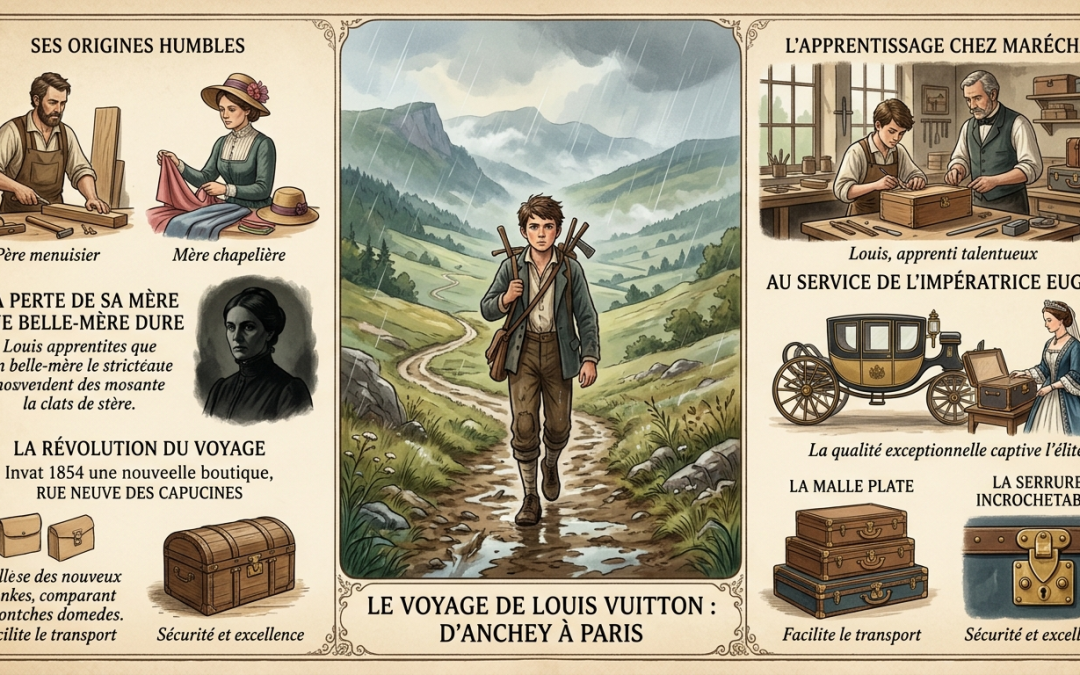
Tout commence en 1821, dans le minuscule hameau d’Anchey, niché au cœur des montagnes isolées du Jura français. Louis Vuitton naît dans un environnement où la rudesse de la nature n’a d’égale que la modestie de ses conditions de vie. Son père est menuisier, sa mère chapelière. Ces métiers, bien que nobles et exigeants, ne permettent qu’une subsistance précaire dans une France rurale encore marquée par les séquelles des guerres napoléoniennes.
Dès ses premières années, le jeune Louis est baigné dans l’odeur du bois fraîchement coupé et la texture des tissus. Il observe avec fascination la précision du geste de son père, la manière dont une planche brute devient un objet utile. Cette éducation informelle à l’artisanat sera le socle de son génie futur. Il comprend très tôt que le travail de la main n’est pas seulement une corvée, mais une forme de survie, voire un art capable de transformer la matière.
Le Drame Familial : Le Déclic de l’Exil
L’enfance de Louis bascule tragiquement lorsqu’il n’a que 10 ans. La perte brutale de sa mère vient briser le fragile équilibre familial. Son père, contraint de subvenir seul aux besoins du foyer, se remarie rapidement. Mais la nouvelle venue, sa belle-mère, s’avère être une femme dure et autoritaire. Pour le jeune Louis, sensible et avide de liberté, le foyer familial se transforme en une prison étouffante.
Les tensions quotidiennes et le manque d’affection poussent le jeune garçon dans ses retranchements. Là où d’autres auraient sombré dans la résignation, Louis développe une ténacité hors du commun. À 13 ans, l’appel de l’ailleurs devient plus fort que la peur de l’inconnu. Il décide de quitter Anchey, sans argent, sans bagages, avec pour seul moteur l’espoir d’une vie meilleure à Paris, la ville lumière qui brille de mille feux dans l’imaginaire des provinciaux de l’époque.
L’Odyssée de 400 Kilomètres : La Marche vers la Destinée
Commence alors un périple épique de plus de 400 kilomètres à pied. Pendant deux années d’errance, Louis Vuitton affronte les éléments : la pluie battante, le vent glacial des plateaux et les hivers enneigés. Sans ressources, he becomes a nomadic forced laborer. Il dort dans des granges, sous les arches des ponts de pierre, ou parfois à la belle étoile, au cœur des forêts denses.
Pour se nourrir, il accepte toutes les tâches, même les plus ingrates. Il est tour à tour porteur de fardeaux, balayeur d’écuries, garçon de ferme. Ces deux années de marche ne sont pas seulement un voyage physique, mais une véritable forge pour son caractère. Chaque pas vers Paris est une leçon d’endurance. Malgré la faim et l’épuisement, une voix intérieure le pousse à continuer. C’est cette force de volonté inébranlable qui forgera, plus tard, la solidité de ses créations.
Paris, la Cité des Possibles : L’Apprentissage chez Maréchal
Lorsqu’il arrive enfin à Paris en 1837, la ville est en pleine effervescence. C’est le début de la révolution industrielle, et le transport ferroviaire commence à poindre. Louis trouve une place d’apprenti chez Monsieur Maréchal, un célèbre « layetier-coffretier-emballeur ». À l’époque, les malles ne sont pas de simples bagages, mais des coffres lourds destinés à protéger les robes de soie et les chapeaux fragiles des aristocrates durant de longs voyages cahoteux.
Le talent naturel de Louis pour le travail du bois et sa compréhension intuitive des structures font merveille. Il apprend à concevoir des malles capables de résister aux chocs tout en restant esthétiques. Rapidement, sa réputation dépasse les murs de l’atelier. On loue sa précision, son intelligence pratique et son souci du détail. Il ne se contente pas de fabriquer, il innove.
Au Service de l’Impératrice : Le Saut vers l’Excellence
Le tournant décisif survient en 1853. Louis Vuitton est nommé emballeur officiel de l’Impératrice Eugénie, l’épouse de Napoléon III. L’Impératrice, icône de mode et grande voyageuse, est séduite par le savoir-faire de ce jeune artisan capable de protéger ses gardes-robes les plus complexes.
Cette proximité avec la cour impériale lui ouvre les portes de la haute société européenne. Louis comprend alors que le bagage est plus qu’un contenant : c’est un symbole de statut social. Il saisit l’importance de conjuguer l’élégance à la fonctionnalité. Cette période de service auprès de l’élite lui permet d’observer les besoins spécifiques des voyageurs de luxe, des besoins qu’il s’apprête à satisfaire avec ses propres créations.
1854 : La Naissance de la Maison Louis Vuitton
Fort de son expérience et de ses économies, Louis Vuitton ouvre sa propre boutique en 1854, rue Neuve-des-Capucines. C’est l’acte de naissance d’un empire. Son slogan est clair : « Emballe avec soin les objets les plus fragiles. Spécialité pour l’emballage des modes ». Mais Louis voit plus loin. Il veut révolutionner la forme même du voyage.
À cette époque, les malles ont des couvercles bombés pour laisser couler l’eau. Cependant, cette forme empêche de les empiler dans les cales des bateaux ou les wagons de train. Louis Vuitton prend un risque audacieux : il crée la malle plate.
Révolutionner le Voyage : De la Malle Bombée à la Malle Plate
La malle plate de Louis Vuitton est une révolution technique. Pour la rendre étanche sans le couvercle bombé, il utilise une toile « Trianon » grise imperméabilisée. Plus légère, plus robuste et surtout empilable, elle devient l’accessoire indispensable de la nouvelle ère du voyage moderne. Le succès est immédiat et fulgurant.
Face au succès, les copieurs ne tardent pas à apparaître. Louis réagit en changeant régulièrement les motifs de ses toiles pour se différencier. Après la toile Trianon, il introduit la toile rayée rouge et beige, puis la célèbre toile Damier en 1888. Cette lutte constante contre la contrefaçon devient l’un des moteurs de la créativité de la maison.
L’Art de la Sécurité : L’Invention de la Serrure Incrochetable
Un autre défi majeur pour les voyageurs de l’époque est le vol. Les malles contiennent souvent des bijoux et des objets de grande valeur. En collaboration with his son Georges, Louis developed a revolutionary locking system. En 1886, ils brevètent une serrure à cinq gorges, un mécanisme si complexe qu’il est considéré comme incrochetable.
Pour prouver l’inviolabilité de leur invention, Louis et Georges lancent un défi public au célèbre magicien et serrurier Harry Houdini. Bien que le défi n’ait jamais eu lieu officiellement, la publicité entourant l’événement consacre la malle Vuitton comme le coffre-fort itinérant ultime. Aujourd’hui encore, ce système de serrure est une référence de la marque.
L’Héritage de Georges Vuitton : L’Expansion et le Monogramme
Louis Vuitton s’éteint en 1892, laissant derrière lui une entreprise prospère. Son fils, Georges Vuitton, prend le relais avec une ambition décuplée. C’est lui qui va transformer l’entreprise familiale en une marque mondiale. En 1896, en hommage à son père, Georges crée le célèbre Monogramme LV : un entrelacement des initiales du fondateur avec des motifs de fleurs et de trèfles inspirés par l’art oriental alors en vogue.
Ce monogramme devient la première véritable signature de luxe au monde. Il n’est plus seulement une marque de propriété, mais un emblème d’appartenance à une élite internationale. Sous l’impulsion de Georges, la maison s’installe à Londres, puis traverse l’Atlantique pour conquérir New York.
Le XXe Siècle : Une Conquête Mondiale Sans Précédent
Le XXe siècle voit la marque s’adapter aux nouvelles formes de mobilité. L’automobile et l’aviation remplacent peu à peu le train et le paquebot. Vuitton crée alors des sacs plus souples, comme le « Steamer Bag » ou le célèbre « Keepall ». La marque ne se contente plus de fabriquer des malles ; elle devient une maison de maroquinerie globale.
Dans les années 1970 et 1980, sous la direction de Henry Racamier, l’entreprise entre dans une nouvelle phase d’expansion financière. La fusion avec Moët Hennessy en 1987 donne naissance au groupe LVMH, propulsant la marque dans une dimension industrielle tout en préservant son héritage artisanal.
L’Ère Marc Jacobs : Quand la Malle Devient Haute Couture
En 1997, Louis Vuitton prend un virage historique en nommant le designer américain Marc Jacobs comme premier directeur artistique. C’est l’entrée fracassante de la maison dans le monde du prêt-à-porter de luxe. Jacobs dépoussière l’image de la marque, la rendant désirable pour une nouvelle génération.
Sous son ère, le sac à main devient un objet de culte. Louis Vuitton n’est plus seulement l’accessoire des voyageurs, mais celui des défilés de mode de Paris, Milan et Tokyo. La fusion entre la tradition malletière et l’avant-garde stylistique est un succès planétaire qui redéfinit les codes du luxe moderne.
Collaborations Artistiques : Le Luxe Rencontre l’Art Contemporain
L’une des stratégies les plus brillantes de la maison Vuitton a été l’ouverture vers l’art. Des collaborations légendaires ont vu le jour avec des artistes comme Takashi Murakami, qui a réinventé le monogramme en couleurs acidulées, ou Yayoi Kusama et ses pois hypnotiques.
L’arrivée de créateurs visionnaires comme Virgil Abloh pour l’homme a également permis de briser les barrières entre le « streetwear » et la haute couture. Chaque collaboration est une occasion pour la marque de se réinventer, prouvant que l’héritage de 1854 est assez solide pour supporter toutes les audaces contemporaines.
Louis Vuitton Aujourd’hui : Un Pilier Indétrônable du Prestige
Aujourd’hui, Louis Vuitton est bien plus qu’une marque de mode ; c’est un phénomène culturel global. Des ateliers d’Asnières, où sont toujours fabriquées les commandes spéciales, aux boutiques futuristes de New York ou Séoul, l’esprit de Louis perdure. La maison continue d’investir dans l’innovation, que ce soit par l’utilisation de nouveaux matériaux ou par des engagements en faveur de la durabilité.
L’histoire de ce petit garçon jurassien qui marchait vers son destin est un rappel puissant : le luxe n’est pas seulement une question de prix, mais de passion, de temps et d’une quête incessante de perfection. Louis Vuitton reste, près de deux siècles plus tard, le symbole vivant de l’incroyable voyage d’un homme qui a su transformer une simple malle en un rêve universel.
Louis Vuitton: The Extraordinary Journey from a Jura Village to the Throne of Luxury
The Humble Roots: A Jura Birthplace
The name Louis Vuitton is now synonymous with opulence, high fashion, and the elite « art of travel. » However, the brand’s origins are far from glamorous. Born in 1821 in Anchey, a tiny, isolated hamlet in the French Jura mountains, Louis grew up in a world of manual labor and survival. His father was a farmer and carpenter; his mother was a milliner.
From a tender age, Louis watched his parents work. He learned the scent of freshly cut timber and the tactile nature of fabrics. These early years instilled in him a fundamental truth: manual work was not just a means of survival, but a form of art. Little did he know that these childhood observations would later revolutionize the way the world traveled.
Family Tragedy: The Spark of Exile
Louis’s world was shattered when he was only 10 years old. His mother passed away suddenly, leaving a void that was quickly filled by a stern and authoritative stepmother. The family home, once a place of learning, became a suffocating prison. For a young boy with a curious mind and a sensitive soul, the life laid out for him in Anchey felt too small.
Driven by a mix of grief and an unshakeable desire for freedom, 13-year-old Louis made a radical decision: he would run away. With no money and only the clothes on his back, he set his sights on Paris—a city over 400 kilometers away.
The 400-Kilometer Odyssey: Walking Toward Destiny
The journey to Paris took two years. Louis was a homeless teenager, walking through rain, wind, and snow. He slept in barns, under bridges, and deep within forests. To survive, he took on the most grueling jobs imaginable: farmhand, stable boy, and porter.
There were days when he didn’t eat. There were nights when the cold was so biting he thought of giving up. Yet, a persistent voice inside him kept repeating one word: CONTINUE. This period of hardship was his true education. It forged a resilience that would later define his business philosophy—nothing is impossible if you have the endurance to see it through.
Paris: The Apprenticeship at Monsieur Maréchal’s
When Louis finally reached Paris in 1837, he found a city on the brink of a transportation revolution. He secured an apprenticeship with Monsieur Maréchal, a renowned box-maker and packer (layetier-coffretier-emballeur). At the time, luggage consisted of heavy, domed trunks designed to allow water to run off during long carriage rides.
Louis’s natural talent with wood and his practical intelligence quickly made him Maréchal’s star apprentice. He didn’t just build boxes; he engineered protection for the most delicate garments of the Parisian elite. His reputation for precision and care began to spread through the city’s salons.
Serving the Empress: A Leap Into High Society
In 1853, Louis’s career reached a turning point. He was appointed as the personal box-maker and packer to Empress Eugénie, the wife of Napoleon III. The Empress was a fashion icon and a frequent traveler; she needed someone who could protect her elaborate silk gowns and fragile hats during her grand voyages.
Working for the Imperial court gave Louis an insider’s view of the luxury world. He realized that for the wealthy, luggage was more than a container—it was a status symbol. He understood that as travel became more frequent and prestigious, baggage needed to be both elegant and functional.
1854: The Birth of the Maison Louis Vuitton
Confident in his skills and backed by a prestigious clientele, Louis opened his own shop in 1854 on Rue Neuve-des-Capucines. He was no longer just an employee; he was a creator. His mission was bold: to modernize the very concept of the travel trunk.
In an era where steamships and trains were replacing horse-drawn carriages, the traditional domed trunks were becoming a nuisance. They were impossible to stack, wasting precious space in cargo holds. Louis took a massive risk and introduced the flat-topped trunk.
Revolutionizing Travel: From Domed Trunks to Flat Elegance
The flat trunk was a technical masterpiece. To ensure it remained waterproof without the domed shape, Louis covered it in a gray « Trianon » waterproof canvas. It was lightweight, durable, and, most importantly, stackable.
The success was instantaneous. However, with success came imitators. To protect his brand, Louis began a lifelong battle against counterfeiting. He constantly innovated his designs, moving from the Trianon canvas to striped patterns, and eventually to the famous Damier (checkerboard) print in 1888. This relentless pursuit of originality became the DNA of the house.
The Art of Security: The Unpickable Lock
Safety was a major concern for 19th-century travelers. Trunks often carried jewelry and fortunes. Working with his son, Georges, Louis developed a revolutionary locking system with a five-tumbler mechanism. It was so advanced that they declared it « unpickable. »
In a stroke of marketing genius, they publicly challenged the famous escape artist Harry Houdini to break out of a Vuitton trunk. While the challenge never actually took place, the publicity cemented the brand’s reputation as the ultimate provider of security and excellence.
Georges Vuitton: The Legacy and the Monogram
Louis Vuitton passed away in 1892, leaving the company in the capable hands of his son, Georges. Georges was a visionary who aimed to take his father’s French success to a global stage. In 1896, as a tribute to his late father, Georges created the LV Monogram.
Featuring the interlocking initials « L » and « V » alongside floral motifs inspired by Japanese art, the Monogram became the first true « luxury logo. » It was more than a trademark; it was a badge of sophistication. Under Georges’ leadership, Louis Vuitton opened stores in London, New York, and Tokyo, transforming the family business into a global empire.
The 20th Century: A Global Conquest
As the 20th century dawned, the brand adapted to the rise of the automobile and aviation. Heavy trunks were complemented by softer, more versatile bags like the « Steamer Bag » and the « Keepall. » The brand was no longer just about trunks; it was about the lifestyle of the modern traveler.
In the 1980s, the merger with Moët Hennessy created LVMH, the world’s largest luxury group. This move provided the financial power to expand into every corner of the globe while maintaining the brand’s commitment to artisanal quality.
The Marc Jacobs Era: When Trunks Met Haute Couture
In 1997, the house took a daring step by appointing American designer Marc Jacobs as its first Creative Director. This marked Louis Vuitton’s official entry into the world of high fashion and ready-to-wear.
Jacobs modernized the brand’s image, making it desirable for a younger, trendier generation. He turned the handbag into a cult object, proving that a brand born in 1854 could still dominate the runways of the 21st century. Tradition was now married to avant-garde creativity.
Artistic Collaborations: Breaking the Rules
One of the brand’s most brilliant strategies has been its collaboration with world-renowned artists. From Takashi Murakami’s colorful reimagining of the monogram to Yayoi Kusama’s hypnotic dots and Virgil Abloh’s revolutionary streetwear influence, Louis Vuitton has consistently pushed the boundaries of what a luxury house can be.
These partnerships keep the brand relevant, blending the world of fine art with high fashion and ensuring that the « LV » logo remains a symbol of contemporary cool.
Louis Vuitton Today: An Unshakeable Pillar of Prestige
Today, Louis Vuitton stands as the ultimate emblem of excellence. From the original workshops in Asnières—where custom orders are still handcrafted—to futuristic flagship stores in Seoul and Paris, the spirit of the young boy from Jura lives on.
The story of Louis Vuitton is a powerful reminder that luxury is not just about price tags; it is about passion, time, and an unceasing quest for perfection. Nearly two centuries after a 13-year-old boy began his long walk to Paris, his name remains the gold standard for dreams, travel, and the enduring power of French craftsmanship.
par guezio.com | Fév 27, 2026 | Motivation for success
Burnout and the Burnout Society . Burnout is no longer a simple professional accident; it has become a true societal phenomenon. Today, 40% of employees report psychological distress, and millions of workers face a severe risk of exhaustion. Yet, this term has barely existed for 50 years. How can we explain this silent epidemic in an era that has never celebrated freedom more?
The Illusion of Freedom: From Discipline to Performance
Our ancestors fought to break physical chains. Today, we no longer have visible masters, kings, or shackles on our feet. Yet, this claimed freedom strangely resembles an open-air prison. If the malaise is collective, it is because its causes go beyond a simple economic framework. They are moral and philosophical.
The South Korean philosopher Byung-Chul Han, in his seminal work The Burnout Society, explains that we have undergone a major paradigm shift. Historically, society was « disciplinary » (as theorized by Michel Foucault). The power dynamic was clear: an exploiter and the exploited. Discipline was imposed through constraint and fear. But this model has limits: it is too visible, too unjust, and ultimately breeds rebellion.
Modern Management or the Art of « Onboarding »
With the shift toward a service-based economy, the primary tool of work is no longer the body, but the brain. However, creativity and intelligence cannot be forced through the whip. Frontal discipline becomes counterproductive. Therefore, organizations have evolved into the Achievement Society.
Modern management no longer seeks to be feared, but to be loved. This is the paradox of Michael Scott in the series The Office: a manager who wants to be « pals » with his employees. Under the guise of benevolence, the goal remains the same: profitability. For an employee to give their best, they must no longer feel constrained; they must feel « onboarded. » The company then becomes an extension of their own identity.
[Image: The transition from disciplinary society (factories, punch clocks) to achievement society (open spaces, digital devices, glowing icons of productivity)]
The Shift from « You Must » to « You Can »
The genius—and the horror—of modern capitalism is having transformed exploitation into self-actualization. We have moved from a world that said « You must » (prohibition, limits) to a world that whispers « You can » (infinite possibility).
This injunction to « achieve » is much more violent than a prohibition. While a physical constraint has limits, the optimization of the self has none. We are urged to optimize:
Our careers (hustle culture),
Our bodies (sports as performance rather than play),
Our sleep (tracked by performance metrics),
Our social relationships.
As Byung-Chul Han points out, we have become « entrepreneurs of ourselves. » The exploiter and the exploited are now one and the same. We no longer need a supervisor: we whip ourselves.
Burnout: When the Machine Saturates with Positivity
Burnout is the breaking point of this system. It is not just physical fatigue; it is psychic saturation. It is the moment when an individual can no longer live up to the image of perfection they have imposed upon themselves.
In this society of excess positivity, saying « no » becomes a betrayal of oneself. Burnout is the alarm signal of a brain that refuses to be merely a production machine. It is the collapse under the unbearable pressure of « becoming better. »
AI and the Myth of the End of Work
One might believe that Artificial Intelligence will save us from this fatigue by taking over the burden. However, history shows us the opposite. In 1930, the economist Keynes predicted a 15-hour work week thanks to technical progress.
What did we do instead? We created « bullshit jobs, » shifted the workload to offices, and intensified the quest for performance. Technology does not solve a problem that is, at its root, philosophical. Performance has no goal other than to sustain itself.
Reclaiming the Right to Negativity and Uselessness
What is the solution? Byung-Chul Han suggests reclaiming the contemplative life. To break the walls of our invisible prison, we must relearn « negativity »: the ability not to do, not to react, and not to optimize.
To embrace one’s burnout is, in a way, to dismantle one’s own self-exploitation. It means accepting to:
Fail at your night’s sleep or your workout without guilt.
Be bored without seeking to fill the void with « useful » content.
Be useless in the eyes of the market.
True freedom is not found in the success of our personal projects, but in our capacity to exist outside of any productivity scheme. Watching a sunset without taking a photo, reading a book for the pleasure of escape and not to acquire a skill—these are the true acts of modern resistance.
Conclusion: Sabotaging the Cult of Performance
The war against exhaustion will not be won with a new productivity tool, but within our own minds. It is time to stop « earning a living » at the cost of mental health. By becoming capable of inactivity again, we take back possession of our time—which, contrary to dogma, is not money, but pure life.
par guezio.com | Nov 14, 2025 | GuézioTV
An article inspired by a true story about the triumph of the spirit over material destitution. The story of Louis, the street child who built impossible bridges.
The Power of Thinking Big . Humanity constantly searches for the keys to success and true wealth. We look for them in banks, prestigious diplomas, or influential networks. However, the story of Louis, a boy whose pockets never knew the weight of coins, reminds us of a fundamental and immutable truth: there are things no money can buy, but that all the money in the world can never steal. This maxim is the golden thread of an extraordinary journey, that of a child who transformed destitution into architecture, proving that the only real limit is the size of our thoughts.
Material Poverty, Cradle of Immense Dreams
Louis’s childhood was a daily struggle against hunger and cold. He sold water on dusty street corners, his small, prematurely calloused hands carrying bottles heavier than his years. In the eyes of the world, he was just a barefoot child in patched clothes, a symbol of poverty printed in every unruly lock of his hair.
But while his pockets were empty, his heart and mind were full. Every night, in the silence of their humble wooden house, Louis indulged in a secret ritual: he drew. With a piece of charcoal and the backs of old discarded papers, he did not draw his reality, but the one he imagined: buildings touching the clouds, bridges defying the impossible, hanging gardens. He created entire worlds, universes of possibilities invisible to those who saw him pass by.
His mother, Madame Éloïse, a woman with an infinite heart and hands made rough by constant work, worried. She knew the cruel implacability of reality. She feared that life would one day crush her son’s wings before he could even learn to fly. She had once dreamed herself, a long time ago, but life had taught her that dreams do not fill stomachs or pay bills. Yet, Louis was different. He carried within him that unquenchable flame that neither reason nor fear could extinguish.
The Encounter That Defied Appearances
Louis’s life took a decisive turn in the central square, in front of a new skyscraper of glass and steel. Forgetting his hunger and his water bottles for a moment, Louis was captivated by this vision. He saw men in suits, the creators of this splendour, and imagined their scrolls of paper as « magical blueprints. »
Quickly chased away by a daunting security guard, he was called back by one of the men in suits, Monsieur Antoine, with grey hair and kindly eyes. Questioned about his interest, Louis replied with a trembling certainty: « Because one day, I will build a building even more beautiful than this one. »
The silence that followed was broken by mocking laughter. How could a barefoot kid, with nothing, dare such ambitions? But Monsieur Antoine did not laugh. Carefully unfolding Louis’s crumpled drawing—a utopian school full of light and smiling children—he saw beyond the destitution. He saw a self-taught genius, proof that greatness does not wait for permission.
Monsieur Antoine offered Louis a card, an appointment at 7 a.m. This card contained no promise of salary, but something infinitely more valuable: access to knowledge.
[presto_player id=3181]
The Silent Learning and the Test of the Impossible Bridge
For months, Louis was « the floor boy. » He cleaned, organized, and made coffee. The other employees treated him with indifference or contempt, cracking jokes about his empty pockets. But in every humble task, his eyes acted like sponges, absorbing every word, every stroke, every technique. He received no salary, but he accumulated an invaluable fortune: experience and knowledge. Monsieur Antoine, for his part, saw fire where others only saw smoke.
The real test came one night. Monsieur Antoine presented him with a challenge that his team of graduate engineers had failed to solve for weeks: how to build a bridge over a very wide river in unstable terrain with a limited budget.
Louis sat down, and thought big. He drew a bridge that defied gravity, an elegant structure that transformed the obstacle into a solution, using the strength of the river itself for support. He had solved in an hour what the elite could not solve in a month.
However, validation from the world is rarely easy. When Monsieur Antoine presented Louis’s project to the investors, the reaction was outrage. A « street kid without formal education » was an insult, threatening everyone’s reputation.
The Mother’s Speech: The Size of Your Thoughts
Louis, heartbroken, returned home. He doubted: « Maybe they are right. Maybe empty pockets mean empty heads. » It was then that his mother, Madame Éloïse, delivered the most important lesson of his life, a philosophy that would change his self-perception and destiny.
She took his face between her calloused hands and uttered these timeless words:
« My son, they can empty your pockets, they can steal your coins, they can even take the roof over your head. But there is one thing that no power in the world can take away: the size of your thoughts. For thinking big does not depend on what you have, but on who you are. »
That night, crystalline clarity replaced despair. Louis realized that his true power was not to be accepted by the world, but to transform it. He did not return to the office as the floor boy, but as someone who had finally understood that empty pockets were just part of the journey, not the final destination.
The Triumph of the Idea over Fortune
The bridge was built, the « Impossible Bridge, » hailed by newspapers worldwide for its elegance and efficiency. At the inauguration party, the very investors who had mocked the boy were now vying for the credit of this marvel.
It was there that Monsieur Antoine revealed the true architect. Louis stepped onto the stage, his feet still bare, his clothes still simple. The silence was deafening. He refused to celebrate, preferring to question the crowd: « How many of you would have applauded when my pockets were empty and all I had were dreams? »
He built this bridge, he said, not to prove the skeptics wrong, but to prove his mother right. She had taught him that the size of our dreams is not measured by the weight of our pockets, but by the strength of our hearts.
True Wealth: Building with a Full Heart
Louis became one of the most respected architects in the world, not for the most expensive skyscrapers, but for his commitment to transforming lives. He created schools in underserved neighborhoods, hospitals in forgotten villages. Every project bore the invisible signature of the boy who dared to think big.
Monsieur Antoine summed up the lesson perfectly: « The greatest wealth we can have is the courage to think beyond what our eyes can see. » And Louis’s mother, who never stopped her simple work, summarized everything with this truth:
« They can take everything from you, except the size of your dreams. »
True wealth is not measured by what we carry in our pockets, but by what we build with our empty hands and our full minds. It is ideas that change the world, not coins. It is dreams that build bridges, not diplomas. The power of thinking big is the birthright of anyone who dares to believe. Your pockets may be empty, but as long as your mind is full of dreams and your heart full of courage, you are richer than any fortune can buy.